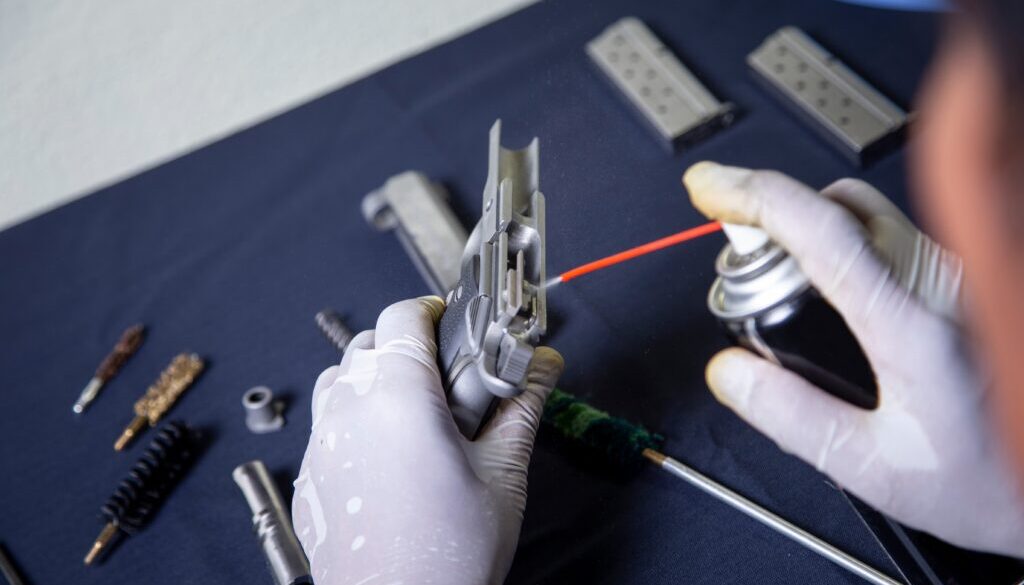
After Range Day: Firearm Cleaning & Maintenance 101
After a shooting range session, firearm maintenance is an important part of routine care, helping keep your firearm clean, properly lubricated, and ready for your next trip. Safety should always come first. While we can give general instructions, you should follow the firearm manufacturer’s instructions before beginning any cleaning or maintenance.
In this guide, MMP Guns will cover essential gun cleaning supplies, basic maintenance practices, how often to clean your firearm, and when professional gunsmith services may be appropriate.
Why Clean Your Firearm After Range Day?
Routine cleaning helps prevent residue and fouling from building up around moving components. Each range session can leave behind carbon, powder residue, and lead or copper fouling in the barrel and action. Regularly addressing this buildup can help maintain internal components, preserve custom finishes, and support reliable operation over time.
Cleaning frequency varies by firearm, ammunition, shooting conditions, and manufacturer recommendations. Establishing a consistent post-range maintenance routine is a practical way to care for your firearm and keep it ready for future use.
How Often Should a Firearm Be Cleaned?
The right maintenance routine depends on manufacturer recommendations, usage frequency, shooting environment, humidity, and ammunition quality. Frequent range use or exposure to harsh elements calls for regular maintenance, while occasional recreational use still benefits from routine inspection.
| Firearm Category & Model | Recommended Cleaning Schedule | Key Focus Areas |
| Glock Platform (e.g., G19, G17) | Clean prior to initial firing, after heavy range sessions, every 400 to 500 rounds, or monthly for carry weapons. | Slide rails, barrel bore, recoil assembly, and light connector lubrication. |
| AR-15 Rifles (e.g., M&P15, Custom AR) | Wipe down after light sessions; deep clean the bolt carrier group every 300 to 500 rounds. | Bolt carrier group carbon removal, star chamber, gas rings, and feed ramps. |
| 1911 / 2011 Handguns | Clean every 300 to 500 rounds; conduct full teardown and inspection every 3,000 to 5,000 rounds. | Frame rail grooves, extractor channel, slide stop notch, and recoil spring inspection. |
| Micro-Compact Carry (e.g., Sig P365, Hellcat) | Clean after every range session; perform a visual check and lint wipe-down monthly. | Striker assembly channel, slide serrations, optic cuts, and magazine release. |
| Semi-Auto Shotguns (e.g., Beretta A400, Benelli M4) | Clean barrel and action after usage; disassemble and clean gas piston system every 500 rounds. | Gas ports, piston assembly, action bars, and magazine tube residue. |
What Gun Cleaning Supplies Do You Need?
Purpose-built maintenance tools can reduce unnecessary wear on internal components and specialized firearm finishes. Basic gun cleaning supplies may include:
- Bore brush or bore snake matched to your firearm’s caliber
- Manufacturer-recommended cleaning solvent
- Cleaning patches for removing residue
- Nylon cleaning brush for appropriate exterior and surface areas
- Gun oil or CLP for cleaning, lubrication, and protection
- Microfiber or lint-free cloth for wiping and finishing
Choose cleaning solvents and lubricants that are compatible with your firearm and its finish. If you’re unsure which products are appropriate, the MMP Guns team in Phoenix, AZ, can help you identify maintenance supplies suited to your firearm and routine.
How to Clean a Gun Safely After Range Day
Step 1: Make Sure the Firearm Is Unloaded
Verifying that the firearm is completely unloaded is the most critical safety step before performing any maintenance. Remove the magazine, clear the chamber, and visually inspect the barrel in a well-lit area completely free of live ammunition.
Step 2: Follow the Manufacturer’s Disassembly Instructions
Field stripping allows access to high-friction components without unnecessary teardown. Always consult your official owner’s manual for correct field-stripping procedures for your specific platform.
Step 3: Clean and Inspect the Components
Apply proper solvents using patches, bore snakes, and nylon brushes to strip away fouling from the barrel, slide, and receiver. Visually inspect during this process for unusual wear or surface damage.
Step 4: Lubricate and Reassemble
Apply lubricant lightly to designated contact points per manufacturer guidelines, as excess oil attracts grit. Reassemble carefully and complete a routine function check.
What Are Common Gun Cleaning Mistakes?
Over-lubricating firearm actions creates a buildup trap for unburned powder and dust. Using household cleaners or WD-40 can break down protective coatings and compromise firearm reliability. Overly aggressive scrub brushes or ignoring owner manual guidelines can cause irreversible physical wear. MMP Guns family of cleaning products are quality products that can be easily deployed to clean and lubricate your firearm, giving you the best possible performance from your firearm.
When Should You Have a Gunsmith Inspect Your Firearm?
Professional inspection is necessary if you notice abnormal mechanical friction, cracked components, or persistent cycling issues. Our skilled gunsmith in Phoenix provides expert diagnostics, repair, and specialized firearm finishing to safely resolve complex mechanical concerns.
Keep Your Firearm Maintenance Routine Simple With MMP Guns
Safe, consistent maintenance starts with following manufacturer recommendations and using the right supplies. Contact MMP Guns today to learn more about our high-quality supplies and expert gunsmithing services. Call us at (602) 279-4417 to learn more.
Image source: MaxShutter / Shutterstock